
The entitlement state … invented to frustrate democracy
Fascinating video on the founder of the modern-day entitlement state. It was none other than Otto von Bismarck, who invented social welfare to frustrate the demand for democratic rule.
The people wanted the power of self-determination. Von Bismarck did not want the poeple to have that power, so he bought their compliance with free stuff. Sound familiar?
Here’s the video from DickMorris.com:
Polls, exit polls in Wisconsin not necessarily wrong
Just before the Wisconsin recall election on Tuesday, the Real Clear Politics website posted its final average. It was a 6.7 % lead for Gov. Walker. Walker won by 6.9 %. That’s close.
In the final hours of the election, theleft-wing media gleefully announced that the exit polling indicated a dead heat, meaning that Mayor Barrett had real shot at winning. The exit polling wasn’t necessarily wrong, it was the reporting. Raw exit poll data should never be reported, because they mean nothing until they are corrected to mitigate the inevitable sources of bias in the sampling.
For example, Jon Cohen wrote yesterday that different types of people vote at different times of day. It’s not hard to imagine that a lot of people who work for a living will vote after they get off work, resulting in a big surge in Republican votes later in the day.
Mr. Cohen identified several sources of bias, but he missed the biggest one. He made several references to “random” sampling. In practice, exit poll sampling is anything but random. I was at the Shannondale Elementary School on Election Day in 2004. Nationally, early exit poll numbers were erroneously being reported to suggest a huge John Kerry win. Democrat operative John Schrum famously asked Sen. Kerry, “Can I be the first to call you Mr. President?”
I heard the reports, but I didn’t believe them because I saw how the exit polling was being done. Process matters. The woman doing the polling, obviously an untrained temporary worker, waited behind a table for people to walk over to her. The people who responded tended to look like her … young, female, and minority. They also appeared to be the people not in a hurry to get back to work. All of these factors would have skewed the exit poll results toward the Democrats on the ballot. There was nothing random about it. I’m sure the scenario I observed was repeated in many other places. Temporary workers would be (I’m guessing) disproportionately young, female, and minority, resulting in more exit-poll respondents from those groups.
Biases in the sample can be corrected, but that process surely takes hours, if not days, to accomplish.
The process for correcting exit poll data was described by Sean Trende:
In other words, the exit pollsters in the field missed a lot of Walker voters. Now, exit pollsters have ways to fix this. For one thing, they weight different regions of the state to the actual vote returns. For example, if northeast Wisconsin exit polls are showing a 50-50 race, and the actual results are 60-40 for Walker, they will simply assign greater weight to a Walker respondent in the region, bringing the reported result in line with the actual result.
… if the non-respondents are disproportionately male, white, and older, the exit pollsters will make sure that the final weights account for those discrepencies.
Going back to Cohen, his bottom line was this: Exit polls tally how different groups voted in an election. They do not predict results.
I wouldn’t get too exited about the suggestion that Tuesday’s exit polling indicates a huge lead for Pres. Obama in the November election. First of all, that election is months away. Further, we never know if they are reporting raw (biased) data or corrected data. Gov. Haley Barbour said Wednesday that the corrected numbers indicate a dead heat. Trende also talked about this in greater detail.
D-Day plus 68 years
On this day, 68 years ago, thousands of brave heroes invaded France on the Normandy coast. They parachuted in from planes, they landed in gliders, they waded ashore, and they climed the cliffs at Pointe du Hoc.
If anything should inspire us to work tirelessly to preserve the lives of preborn children today, it is the sacrifice that so many of these young men, barely more than children themselves, made on those beaches 68 years ago today.
On the 40th anniversary of this day, President Ronald Reagan visited the site and delivered this address:
Planned Parenthood acts boldly against institutional hypocrisy, fires peon
In a bold move to stamp out institutional hypocrisy, Planned Parenthood (PP) has fired Rebecca, an entry-level counselor in Texas … because she couldn’t implement — or did implement, we can’t figure out which — PP’s self-contradictory policy on sex-selection abortions. It’s confusing, because it is apparently PP policy to condemn, support, and be nonjudgmental on sex-selection abortions, all at the same time!
At any rate, the counselor offered PP’s services to perform the abortion, an abortion it is their policy to peform, yet they fired her for it. Confused yet?
In a related matter, PP Executive Director Cecile Richards, despite having a full staff and plenty of time to prepare a thoughtful statement, couldn’t even explain the policy, at least not coherently. But she gets to keep her $400,000/yr job.
Here’s what PP has said about the sex-selection abortions that they themselves commit and profit from:
- PP: “Planned Parenthood condemns sex selection [abortions].” (source)
- PP: “We oppose sex selection abortion.” (source)
- PP “strongly opposes” limits on sex selection abortion. Specifically, PP opposes HR 3541, which would prevent sex-selection abortions, because it “will have the result of further shaming and stigmatizing women” who would use abortion to kill their female offspring. (source) [Note: It would be awful for PP to “shame and stigmatize” an act that PP profits from but claims to “condemn.”]
- PP provides “nonjudgmental” reproductive health care (i.e., abortions), apparently including sex-selection abortions that PP claims to condemn. (source)
- “No Planned Parenthood clinic will deny a woman an abortion based on her reasons for wanting one, except in those states that explicitly prohibit sex-selective abortions.” (story by leftist website Huffington Post, summarizing statement by a PP spokesperson)
How does PP “condemn” a practice that they themselves commit and profit from as a matter of policy? And how do they “condemn” the practice in a “nonjudgmental” way? … You can’t make this stuff up!
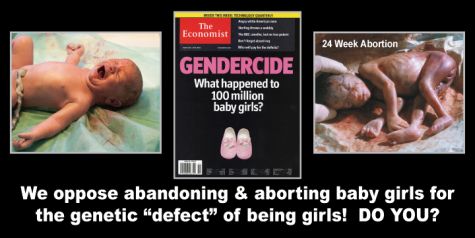
There are many ways to combat injustice, and each can be important because each can reach a different audience. At CBR … that’s my day job … we expose abortion using pictures. At Live Action, they expose the abortion industry’s war on women. Over and over again, PP has been caught on tape aiding and abetting the sexual abuse of minor children and even sex trafficking.
Earlier this week, Live Action released a video in which a PP counselor in Texas was confronted with a Live Action operative posing as a woman seeking to kill her child … if it were a girl. She wanted a boy. True to PP policy, the counselor provided “nonjudgmental” counseling and offered PP’s assistance if she found out later that she was pregnant with an unwanted female child.
As soon as Live Action released the video, PP fired the counselor involved. But of course, PP couldn’t explain what policy she violated. She told the client the same things that PP has said publicly … that PP will abortion your child in a “nonjudgmental” way. Perhaps the only way PP can deal with institutional hypocrisy is to fire the poor menial at the bottom of the org chart.
Efforts like Live Action’s ProtectOurGirls.com are important because they expose the deep chasm between the American people, who want abortion to be legal only in certain circumstances, and Planned Parenthood, who makes huge profits when abortion is unlimited and is subsidized by your dollars (follow the money).
Here is the first video report from Live Action:
.
Komen gets a black eye on Black-Eyed Susan Day at the Preakness
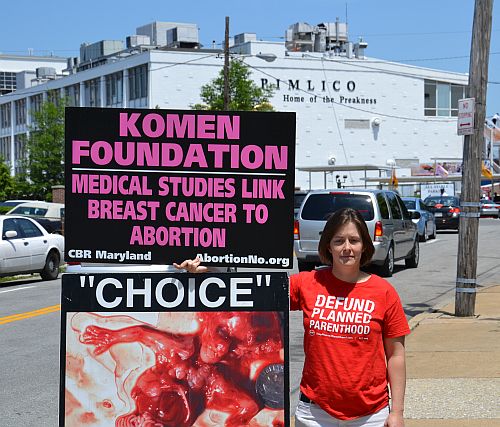
Samantha Linnemann exposes the Komen-abortion-cancer linkage.
Another great story from Kurt Linnemann at CBR Maryland:
Komen gets a black eye on Black-Eyed Susan Day at the Preakness.
Friday, May 18th was Black-Eyed Susan Day at the Pimlico Racetrack in Baltimore, MD. This special event, which is part of Preakness Week at Pimlico, features female jockeys and live entertainment. For the past several years, some of the proceeds from Black Eyed Susan Day have gone to the Susan G. Komen Foundation, the breast cancer research fundraiser. Komen, of course, is still funneling money to Planned Parenthood, the nation’s largest abortion provider, while brazenly denying the large body of evidence that abortion is a major risk factor for breast cancer.
To highlight this outrageous situation, Center for Bio-Ethical Reform (CBR) Maryland conducted a pro-life witness outside the entrance to Pimlico featuring graphic images of abortion and signs calling on Komen to defund Planned Parenthood. Horse racing enthusiasts, most of whom had never seen anything of this sort and certainly didn’t expect to see it at Pimlico, were visibly surprised. While many responded scornfully, others stopped to tell us they had never known about Komen’s support for Planned Parenthood, nor the link between abortion and breast cancer. One post-abortive woman, showing no signs of animosity, stopped to speak with us for nearly an hour and even helped hold a sign!
This is the third time this year that CBR has demonstrated at a Komen Race. We know that our actions are making both Komen and their patrons very uncomfortable. Our hope is that the Komen Foundation will realize that they have brought this upon themselves, and reverse their misguided and tragic decision to fund the nation’s largest abortion provider.
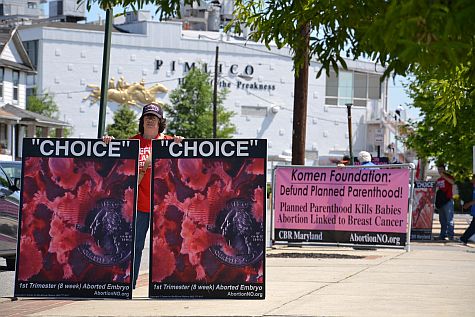
Signs are force multipliers; they allow us to make a huge impact with just a few people.
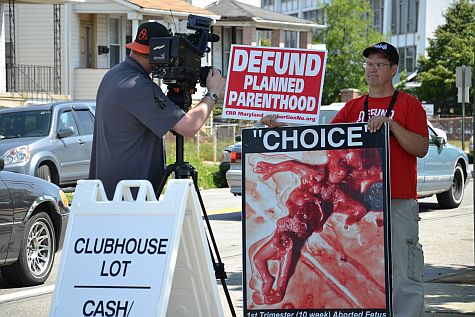
Media helps expand the impact. Here's Kurt Linnemann on the local news.
Pro Life on Campus at the U of Cincinnati
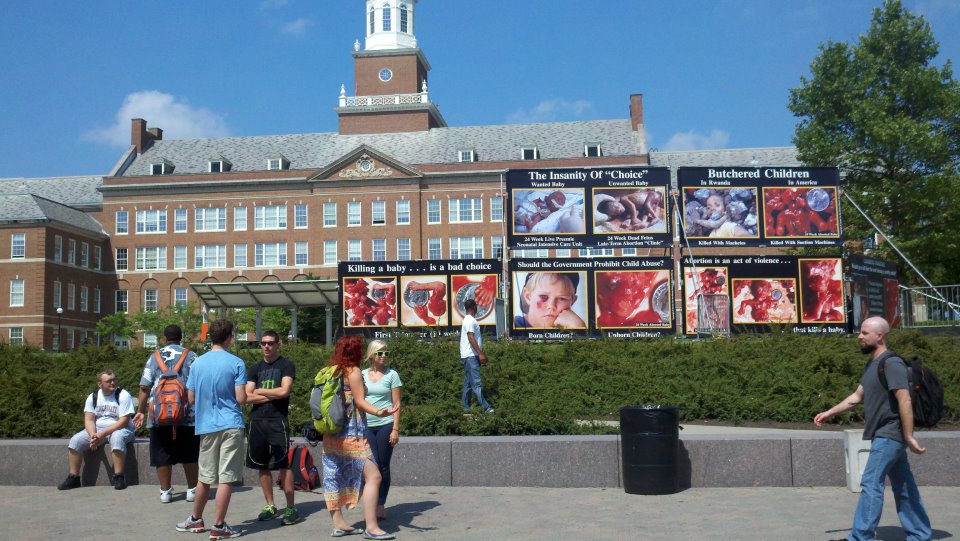
GAP at University of Cincinnati
Day 1 at the University of Cincinnati was awesome, as always. We encountered a steady stream of students willing to ask the typical questions and thoughtfully consider the case against abortion. Time after time, students told us, “That really makes sense” and “I can see your point.”
This will be our last GAP for the 2011-2013 academic year, and I have to telly ou that the cupboard is empty. I already have invitations for the Fall, but can I keep them. Only you can decide. When you support us, we can visit the largest and most influential universities. Say YES to pro-life students by supporting their work … Click here.
Raining on Komen’s parade
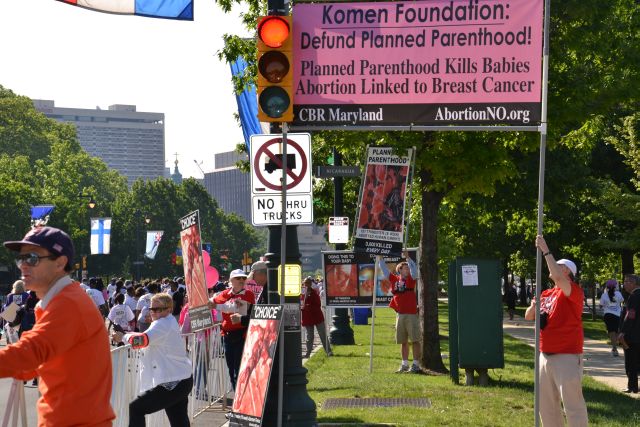
CBR takes its position along the Komen route. Up to 40,000 people were confronted with Komen's support for abortion, which has been linked to breast cancer in a number of medical studies.
This story was submitted by CBR Maryland Director Kurt Linnemann.
Raining on Komen’s Parade
Sunday, May13th, was a bright and balmy day in Philadelphia, PA, but participants at the Philadelphia Susan G. Komen Race for the Cure may have felt that their parade was being rained upon. The Center for Bio-Ethical Reform (CBR) Maryland was on scene, holding the Komen Foundation to account for funding Planned Parenthood, the nation’s largest abortion provider.
We deployed an enormous pink banner that called Komen to account for its irresponsible behavior. CBR volunteers displayed images of aborted children or held signs exposing the link between abortion and breast cancer, which makes Komen’s relationship to Planned Parenthood even more nefarious). Most of the 40,000 race participants saw us and got the message. This is Komen’s worst nightmare.
A lot of people, including many pro-lifers, might find such tactics distasteful, and certainly we didn’t make many friends that day, but I’m afraid polite discussion didn’t work. After all the emails, letters and phone calls earlier this year, the Susan G. Komen Foundation continued to fund baby killing. This is an outrage that demands a response.
Pro-lifers don’t need to be popular to be effective. In fact, the most successful reformers are genuinely hated, until public opinion changes. Confident in this knowledge, we will continue our highly successful campaign of public embarrassment until the Komen Foundation sees the error of its ways. When that happens, I think a parade will be in order!
We attended a Planned Parenthood fundraiser!

Framing Choice. As Planned Parenthood presents what choice means to born people, we display what choice means to the victim. Other signs are visible to the Market Square crowd in the background.
What a difference a year makes. In February 2011, Alaynna McCormick was at the center of controversy in Knoxville. She and her mother blew the whistle on Knox County Schools for allowing Planned Parenthood (PP) to market sex at Hardin Valley High School. Story here, here, here, here, and here.
Note: if you think the claim that “PP markets sex” is an unfair statement of what they do, consider the fact that students were invited to visit websites that would then encourage teenagers to have sex if, among other things, they “trust each other,” “care about each other,” and “have fun together.” Link here. Follow the money here.
On Friday evening, PP held their annual “Framing Choice” photo exhibit at Market Square in Knoxville. This year’s theme was “What Choice Means to Me.” So Alaynna and a few of her family and friends brought their own photographs … a set of CBR “Choice” signs.
We put 8 such signs on display in between the stage, where the PP event was taking place, and the rest of Market Square, where the usual Friday night crowd was having dinner and milling around the Square. In keeping with the theme of the event, we added titles like, “What did choice mean to this child?” and “Did this child have a choice?”
We got a lot of good interaction with passersby. We saw several parents use the signs as a teaching moment, to explain abortion to their young children. We’ve never seen a young child who is pro-abortion. None of these children were tramatized by the pictures.
We were approached by some who objected to our presence, giving the teenagers opportunities to practice the apologetics we taught them the night before. We gave them an abbreviated version of our Pro Life Training Academy (PLTA). All of the teenagers who attended the PLTA have asked to help with future GAPs.
Planning elements of a successful event at Market Square:
- Use graphic images to give meaning to the word abortion.
- Give prior notification of our plans to the Police Department.
- Occupy public spaces only; do not trespass on PP’s reservation.
- Set up security camcorder; assign security captain.
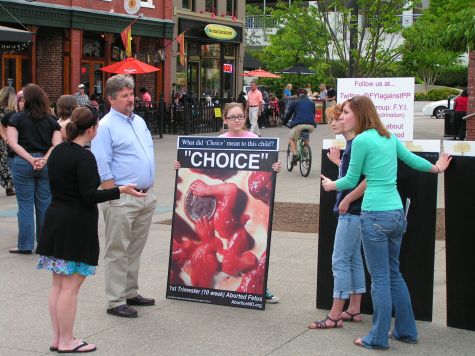
The Pro Life Training Academy (PLTA) has prepared these teenagers to answer pro-abortion objections.
Abortion in Tennessee: Extensive series in the Nashville Tennessean
The Nashville Tennessean has published an extensive series on abortion in Tennessee. Did they get it right? Please comment below! Here are the links:
Abortion in Tennessee
The Debate
- TN, with few restrictions, attracts out-of-state women seeking abortions
- Churches shift positions on abortion
- TN man’s fight to stop embryo donation set stage for abortion rights
The People
- 2 women, 2 clinics. 1 goal: To help
- At 40, Memphis abortion clinic gets bold with its mission
- Fort Campbell woman changed mind after husband landed job
- 17-year-old knew decision as soon as she saw baby’s heartbeat
- ‘It still hurts,’ says woman who had abortion in 1979
- ‘I think God forgives and I will be fine’
- Nashville pregnancy center helps women sort out warring emotions
The Data
CBR exposes abortion-breast cancer link at Komen race
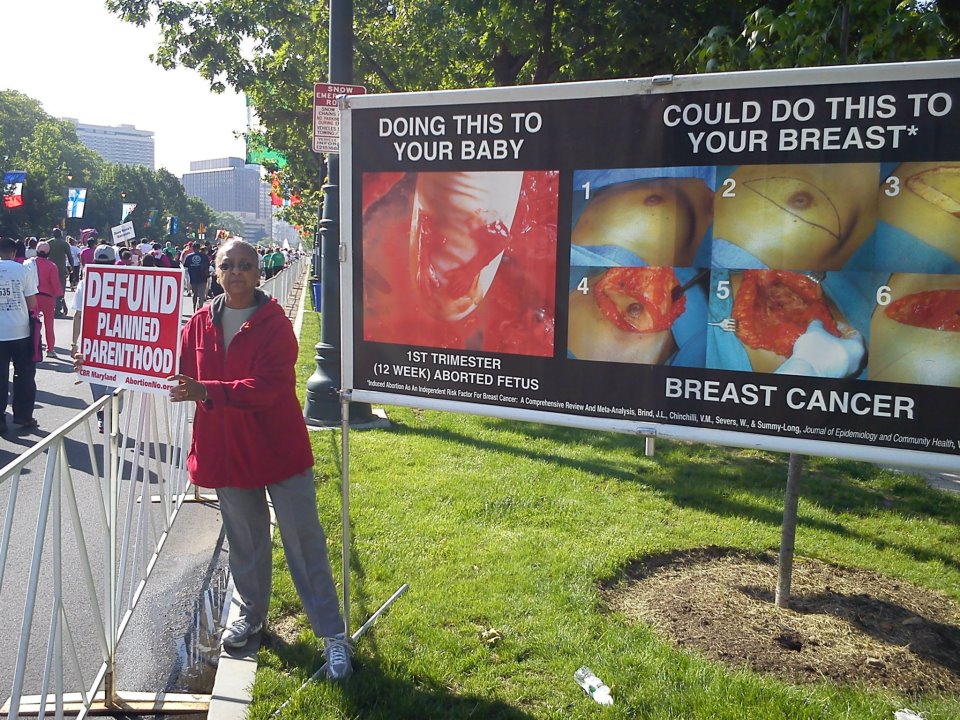
Our GAP sign highlights the fact that Komen is likely causing breast cancer deaths by supporting the abortion industry. An estimated 8,000 women die every year from abortion-related breast cancer.
Now that the Susan G. Komen Foundation is again funding the nation’s largest abortion provider, CBR is exposing the link between abortion and breast cancer. What better venue than Komen for the Cure races in cities across the country?
CBR Maryland attended Komen’s Race for the Cure in Philadelphia just last weekend.
For more information on the statistical link between abortion and breast cancer, click here. An estimated 8.000 women die from abortion-related breast cancer every year (source).
More photos from the Komen for the Cure race in Philadelphia here.
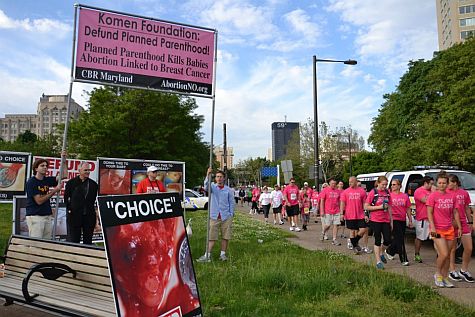
People passed our signs 3 times: coming to the race from the parking area, at the start line, and at the finish line.
BBC belligerence toward CBR Director apparently backfired
Blogging for The Telegraph, Cristina Odone wrote that CBR’s Gregg Cunningham got the better of BBC’s John Humphrys in their recent interview (reported here).
Professional pro-aborts learned not to debate us a long time ago — facts and logic make them look silly and they know it — but sometimes the amateurs think besting us will be easy. This is the mistake that Humphrys made with Cunningham, and Odone pounced on it. She wrote, in part:
Things, however, didn’t go according to plan. Despite John Humphrys’s grilling – Humphrys brought up a comparison Cunningham had apparently made of abortion with the Holocaust – Cunningham struck a few blows himself. Yes, he was using horrific images to raise awareness of abortion – but abortion is horrific; and William Wilberforce, in his campaign to end slavery, also used disturbing images of slavery to bring home to the British public what British colonials were doing in the West Indies.
Commenters also chimed in. Commenter Fallada wrote:
It was plain to me that, as Christina Odone suggests, Humphrys thought Cunningham would be easy prey – easily exposed as a nutcase – but Cunningham was quietly insistent, articulate, agile and sensible. In reaction, Humphrys, it seemed to me, grew increasingly irritated and slightly hysterical. Cunningham proved one of the most effective interviewees in dealing with Humphrys that I have heard in a very long time while Humphrys sounded partisan.
Commenter JessicaHof wrote:
I, too, wondered at the idea of showing pictures, but Cunningham’s argument about Wilberforce showing pictures of the conditions in which slaves were kept seemed compelling. Slave-owners and their lobbyists, who argued that slaves were not fully human, found that one hard to support when people saw that they were. I thought Humphrys ended up sounding shrill and somewhat indignant. How dare someone come on the programme and say something which so defied the liberal consensus, and how dare he do so in such a manner. I have to say that Cunningham made me think again about my own attitude, which has tended to be somewhat liberal.
Entire column (including comments) here.
Sex Education Reform in Tennessee … stunning video
From the National Abstinence Education Association (NAEA):
On Friday, May 11, Governor Bill Haslam signed the new Tennessee sex education bill (SB 3310) into law. The bill was initiated in large part due to parental outrage over explicit sex education taught in Nashville schools. The new law sets a standard for other states to follow. It places a clear priority on sexual risk avoidance abstinence education. The law also puts provisions in place that will prohibit explicit sex education from being implemented in classrooms – a first for any state. It also empowers parents to protect their children from harmful sex education through their right to pursue legal options should a school ignore the protective provisions of the law.
The sex education bill received broad bipartisan support in the Legislature. Tennessee Legislator, Rep. John DeBerry (D-Memphis) earned an enthusiastic standing ovation for his straight talking defense of the bill which encourages youth to choose healthy behaviors.
Read the story on “gateway sexual behavior” here. Be sure to read the entire story. Opponents tried to lampoon the bill, saying it banned hugging and holding hands, but Rep. DeBerry (D-Memphis) stood up to set the record straight. Watch Rep. DeBerry’s speech in the Tennessee Legislature here:
Abortion and breast cancer: Facts, lies, and statistics
Among all the pro-abortion myths, the assertion that the abortion-breast cancer (ABC) link has been “disproven” is among the easiest to debunk. But you have to have your references with you. And to really close the sale, you have to understand some basic statistics.
Three factors make this discussion more complex:
- Statistical analysis doesn’t “prove” anything, it only manages uncertainty. An analysis that “shows a statistically significant relationship” between abortion and breast cancer doesn’t definitively prove a relationship exists, and a study that “fails to show a statistically significant relationship” certainly doesn’t prove that it doesn’t exist. There is a big difference between failing to find something and proving that it’s not there.
- Even if you find an independent statistical relationship in the data, that statistical link doesn’t prove that a causality link exists. So even if the statistical link were undisputable, it would be wrong for us to say that abortion definitely causes breast cancer until the biological causal mechanism is established. However, plausible causal mechanisms have been proposed.
- The effect of delaying childbirth is also a risk factor. Because abortion, by its very nature, causes a delay in childbirth, it is easy to see how some might believe that the delayed-childbirth effect is the real culprit, and abortion is no more a risk factor than simply failing to get pregnant. However, you need to know that the abortion effect has been measured independently of the delayed-childbearing effect.
- The most self-assured antagonists in your audience are sometimes the ones who don’t have a clue about statistical analysis. All they know is the party line, but they are quick to tell you how smart they are and how stupid you are. However, others in your audience are listening, and they are the ones you are patiently trying to reach. Reach them with reason, not anger.
To paraphrase Alexander Pope, a little knowledge of statistics is a dangerous thing. I had a boss once who had taken one class in statistics, and his statistical conclusions were downright horrific. I got a PhD minor in experimental statistics, and the more I learned about it, the more I learned to be careful. Therefore, I actually had one of my long-time-ago statistics professors review this post.
Here’s how to respond to the assertion that the ABC link has been “disproven”:
Step 1. Show your audience a recent study that shows the statistical link; it helps if the paper is co-authored by a person who has previously denied the link. Here is a paper that is important for two reasons: (a) it is recent and (b) it was co-authored by Dr. Louise Brinton, the chairperson of the 2003 NCI workshop that declared abortion not to be a risk factor for breast cancer. This paper, which she co-authored in 2009, reported that abortion was indeed associated with a 40% increase in cancer risk. (See the occurrence ratio of 1.4 reported for abortion at bottom of page 1158.)
The increase in cancer risk measured in this study was statistically significant at the 95% level, which means that there is less than a 5% probability of a “false positive.” (A false positive, in this case, would mean that you detected a difference in cancer risk due to abortion that doesn’t actually exist, a difference that is based solely on random sampling error.)
Keep in mind that if there is no difference in cancer risk due to abortion, and you test at the 95% level of confidence, you will detect the non-existent difference (i.e., get a false positive) 5% of the time, or 1 time in 20, based solely on random sampling error. Because of the possibility of false positives, we would want to see more studies.
Step 2. Show your audience a compilation of studies. The Breast Cancer Prevention Institute (BCPI) has assembled a list of 68 studies that tested for the link. Nearly half of the studies cited (31 of 68) found a statistically significant increase in cancer risk associated with abortion. In other words, in 31 studies, the data shows that the abortion group has a higher risk than the non-abortion group. That’s still not enough to prove causality, but we can be confident that the statistical link is real.
When you produce this list for your audience, be sure to disclose that the BCPI has a pro-life agenda, and that your audience should read the studies and decide for themselves. I say to students, “Don’t let people with opinions, including me, tell you what to believe; you have to do the research yourself.”
The other 37 studies “fail to show that the cancer risk is elevated due to abortion.” But “failing to show” an elevated risk is not equivalent to “proving” that there is no elevated risk. A statistical analysis can’t prove that the risk is exactly the same, it can only “fail to show” that the risk is elevated. Until you understand this point, do not attempt to explain Steps 3 and 4, just go directly to the Conclusion (below).
Step 3 (optional). Explain the concepts of statistical significance, false positives and false negatives. This is tricky to explain, but data can “show that the cancer risk due to abortion is elevated at a statistically significant level,” or they can “fail to show that the cancer risk is elevated at a statistically significant level,” but the data can never show that the cancer risk is not at all elevated.
Before a researcher performs the statistical test, he must first set the “level of significance” for that test, usually 1%, 5% or 10%. This is the level of “false positives” he is willing to accept. In other words, if he sets the level of significance at 5% (alpha=0.05), then that means if he finds a difference between the “control” group and the “test” group (e.g., between the non-abortion group and the abortion group) that is statistically significant, he can be 95% sure that the difference actually exists and is not due to random sampling error. There is only a 5% chance that he will measure a positive difference that isn’t really there (i.e., a false positive).
But the lower he sets the likelihood of false positives, the greater the opportunity for false negatives (i.e., stating “no difference” when one exists). If his data shows an increase in risk within the abortion group, but he can be only 89% confident that the measured increase is real and not due to random sampling error, he still has to report that the elevated risk from abortion is “not statistically significant at the 95% level.” He might be 89% sure, but he’s not 95% sure, so he has to report “no difference.” Consequently, a failure to find a statistically significant risk elevation is not proof that the risk isn’t elevated. It might only mean that he does not have enough data to confirm that the measured risk elevation is “statistically significant.”
Step 4 (optional). Explain that the difference between the groups is difficult to show at a statistically significant level because the difference is not all that big. The ambient cancer risk among women is about 10%. Abortion appears to increase the risk of breast cancer to about 13% or 14%, which is a 30% or 40% increase in cancer risk. A difference of only 3 or 4% is difficult to measure statistically—you need a large dataset to do it—but it’s an important difference to the estimated 300,000 or 400,000 women who got cancer because of their abortions.
An abortion-related increase in cancer risk from 10% to only 13% is enough to kill more than 300,000 deaths since Roe (source), which is about 8,000 women per year. But because measuring an increase of this magnitude in an individual study is difficult, the opportunity for false negatives is high, which could explain why some of the studies in the BCPI compilation fail to find the increase.
Conclusions.
- We can never be fairly criticized for saying that abortion is a possible risk factor for breast cancer. According to a recent compilation, 31 of 68 studies have shown a statistical relationship, even if the causal mechanisms have not been established.
- The accusation that the ABC link has been “proven” false is made by people who don’t understand how science and statistics work. The lower a researcher establishes the likelihood of a false positive (normally 1%, 5%, or 10%), the greater the opportunity for a false negative (i.e., stating “no difference” when one exists).
- There are many in the medical community who believe there is more evidence for the link than against it.
More Information:
Pro Life on Campus at Ohio State University
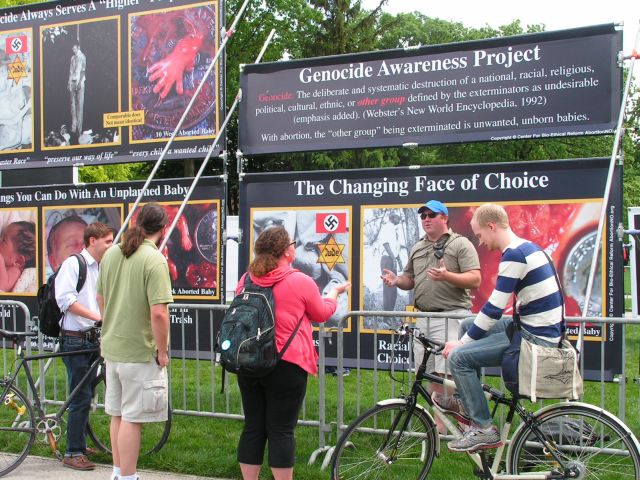
CBR Volunteer Bryan McKinney speaks to a group of students.
Day 1 of the Genocide Awareness Project (GAP) at Ohio State University (OSU) is in the books! Great day with awesome opportunities to share the pro-life message. Several students told us that they could not rebut our arguments and would seriously consider changing their minds.
One international student said he wanted to go back to his homeland and change minds there (name of country withheld intentionally).
Many pro-life students and faculty members approached us and thanked us for coming!
Awesome day! More to come!
Time to Change Pro-Life Tactics? John Jakubczyk responds.
A recent article in Crisis Magazine suggested it was time to change pro-life tactics. Not sure how useful the article is; of the 3.3 points (out of 4) that he got correct, most of it has been well-known to pro-life activists for a long time. The best part about the article was the appended comment by John J. Jakubczyk of Arizona. [Question: How do you say “Jakubczyk”? Answer: With your mouth.]
Anyway, I’m extracting part of his comment here:
It is true that most people do not enjoy hearing about abortion, be they pro-life or “pro-choice.” There is a simple reason for this and it applies to the average church goer all the way to presidential candidates: Once you seriously realize that we are allowing the killing of children every day in this country AND that despite this knowledge we are going about our lives as if nothing is wrong, we are all culpable unless we do something to stop it. And once we realize that, there is no going back. You can NEVER walk away. So we close our eyes and cover our ears and pretend … pretend that those pro-lifers are extremists, pretend that it is just another “ministry,” pretend that their tactics won’t work and therefore I do not need to get involved. We get mad when someone “guilts” us into doing something and we resent them, so we call them zealots or other names. We tell ourselves that we are not like them. And we justify our inaction.
Fortunately many of our children, now grown, abortion survivors, reject this complacency. They want to end the killing. They see the urgency and demand action now. Fortunately there are new leaders who are not willing to go slow, but want to end the killing NOW. They have great drive. It is my prayer that their intensity, their sense of urgency, combined with the wisdom of their elders will forge a new and stronger pro-life movement where their will be no compromise on the principles of protecting all life, that there will be a better use of media to reach the public and SELL the pro-life message, and that there will be a new collaboration among pro-life organizations to defeat the abortion industry on their own turf … by offering women REAL health care for them and their babies, and by exposing the abortion industry’s dark and deviant side to the American public.